Text of the speech by the Director General of the National School of Administration, Journalism and Magistracy, Dr Mohamed Yahya Ould Saïd, at the graduation of the School’s forty-sixth class:
In the name of God, the Most Gracious, the Most Merciful,
and peace and blessings be upon the noble Prophet.
Mr President of the Republic,
Mr Prime Minister,
Mr Speaker of the National Assembly,
Mr President of the Constitutional Council,
Mr Leader of the Democratic Opposition,
Honourable Ministers,
Your Excellencies the Ambassadors,
Mr Governor of Nouakchott West,
Madam President of the Nouakchott Region,
Mr Prefect of Tevragh Zeina,
Mr Mayor of Tevragh Zeina,
Commanders of the security and armed forces,
Mr Chairman of the Board of Directors of the National School of Administration, Journalism and Magistracy,
Members of the School’s teaching and administrative community,
Dear graduates,
Distinguished guests,
The progress of states and the development of nations are measured by the talent they possess and the skills they master. Building human capital and strengthening national expertise have therefore become the foundation of leadership in our time and a key benchmark of development and prosperity. This, Mr President, is something to which you have given unparalleled attention, and today we celebrate with you the realisation of your far-sighted vision in this field, on the occasion of the graduation of a new class of trainees from the National School of Administration, Journalism and Magistracy.
Mr President,
The National School of Administration, Journalism and Magistracy can take pride in having been, three years ago, the platform for your landmark speech setting out your vision for reforming and modernising the administration, bringing it closer to citizens and entrenching justice and fairness. That speech launched major reforms whose benefits we enjoy today throughout our beloved country. At the School, we are proud of the role entrusted to us in implementing this direction: in initial training, in continuing education and in contributing to the design and implementation of reform programmes.
In keeping with this approach, and drawing on the School’s long history, we have sought to remain worthy of the trust the government places in us: initial training programmes, curricula and tools are constantly evolving, as are the continuing education programmes, which have benefited some 8,000 public-sector employees over the past three years. The School has also strengthened its position as a centre of excellence and expertise in its fields.
Today, more than ever, it is able to fulfil its noble national mission, guided by a strategic vision built on four pillars:
- strengthening the institutional framework;
- developing the teaching system;
- reviewing and upgrading continuing education;
- promoting academic and research activities.
With God’s help, work to implement this vision is already under way, with the support of Prime Minister El Moctar Ould Djay and his government and thanks to the combined efforts of the School’s academic and administrative staff. Over the past ten months, administrative and teaching procedures have been digitised; the quality of training has been improved through practical programmes such as the “Experience Talks” series and field visits; continuing education has been expanded; scientific research and publishing have been strengthened; and cooperation with national and international institutions has been developed, alongside a modernised visual identity and communication platforms.
Mr President,
Your decision to attend this graduation ceremony in person is a generous gesture that reflects your deep commitment to human capital and your regard for the future leaders and professionals who are the backbone of the nation’s renewal and the guarantee of its progress on the path of development that you are leading.
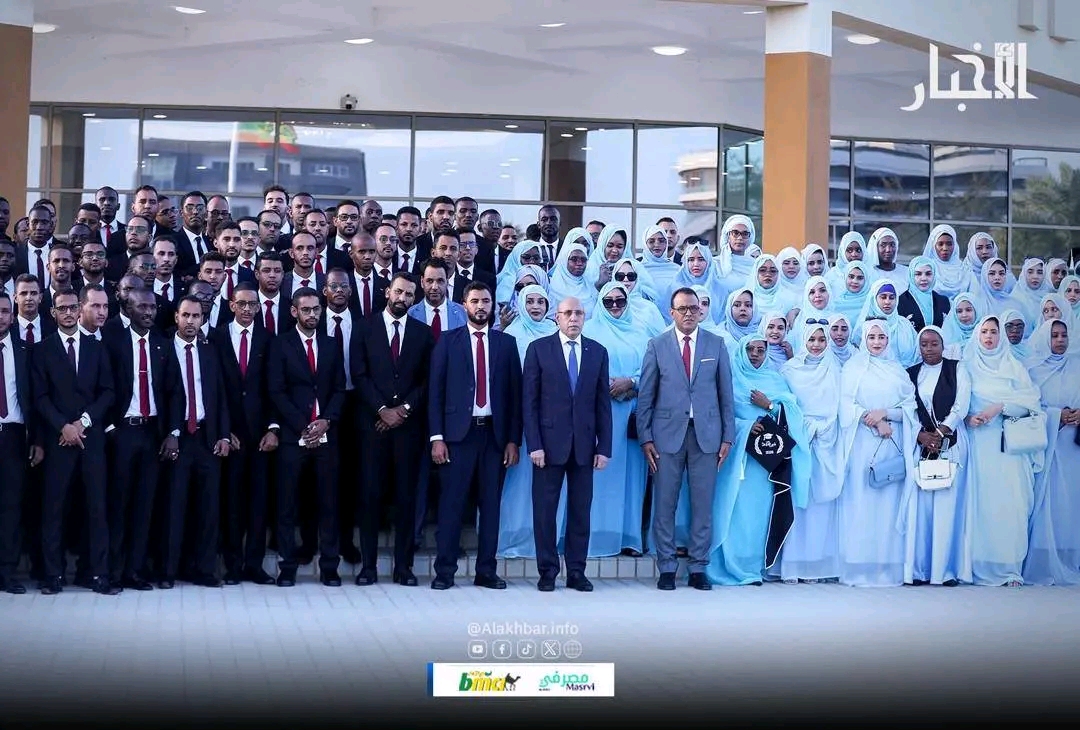
This class, whose graduation you are presiding over today, meets the needs of several key government departments, including:
- Ministry of Justice: 61 graduates;
- Ministry of Foreign Affairs: 10 graduates;
- Ministry of the Interior: 30 graduates;
- Ministry of Finance: 60 graduates;
- Ministry of the Civil Service: 15 graduates;
- Ministry of Trade: 60 graduates.
That is a total of 236 graduates, including 77 women, or 32.63%.
This class has been named after the late Barro Abdallahi. The choice is no accident: he began his life in education and ended it there, through the duties you entrusted to him, Mr President, in building the republican school (as a member of the Higher Council for Education). Between those two milestones he had a distinguished administrative career, including leading this School during its founding period.
This places on this class the responsibility of embodying the qualities that distinguished him: patriotism, wisdom, broad knowledge, dedication and integrity. We are confident that you, dear graduates, will rise to this challenge, thanks to your in-depth training covering both theory and practice, and to the ideals and values of service to the Republic that you now carry.
I congratulate you and wish you every success in your careers.
Mr President,
The National School of Administration, Journalism and Magistracy is now approaching its sixtieth anniversary (it is the oldest institution of higher education in our country). For the first time in the country’s history, thanks to your guidance, it has a fitting headquarters, and it is at the heart of the transformation the administration is undergoing under your leadership. We are grateful for this and strive to ensure that the institution always lives up to your valued trust, linking its promising present to its glorious past.
Peace, mercy and blessings of God be upon you.